
Plan backward across weekends and days off: a counted example
Before subtracting business days, define which days can be worked and whether the deadline date itself counts. A calendar cannot infer your organisation’s holidays or how a contract counts days. This is an illustrative planning method, not a legal deadline calculator.
Inclusive work dates, ending November 20, 2026
| Stage | Chosen working dates | Count |
|---|---|---|
| Scope | Oct 30; Nov 2 | 2 |
| Production | Nov 3, 4, 5, 6, 9, 10 | 6 |
| Review | Nov 12, 13, 16, 17, 18 | 5 |
| QA | Nov 19, 20 | 2 |
| Excluded inside the span | Oct 31; Nov 1, 7, 8, 14, 15 weekends; Nov 11 chosen day off | 7 calendar dates |
Choose the counting convention first
For this example, working days are Monday–Friday except November 11, 2026, which this fictional team has explicitly chosen as a day off. Do not assume that date is a holiday for every reader. The deadline is Friday November 20 at 17:00 and includes a full final workday.
If the cut-off were Friday at 09:00, Friday would not supply a full working day before it. Agree that convention before placing the first work block. For formal filing or contractual deadlines, use the governing rule rather than this generic example.
Count dates one by one when exclusions exist
Starting at the chosen final eligible day, count it, step backward one date, skip every weekend or listed day off, and repeat until the required count is reached. This handles consecutive holidays and any newly crossed weekend without a fragile add-one-calendar-day shortcut.
Without holidays, subtracting five prior weekdays from a weekday lands seven calendar days earlier. That is a different operation from counting five working dates inclusively ending on the deadline. Label your count so those conventions do not get mixed.
Worked example: fifteen working dates in four stages
Count November 20 as working date 15. Final QA uses November 19–20 (two dates). Stakeholder review uses November 12, 13, 16, 17 and 18 (five dates). Production uses November 3, 4, 5, 6, 9 and 10 (six dates). Scope uses October 30 and November 2 (two dates).
That is 2 + 5 + 6 + 2 = 15 working dates. October 30 through November 20 inclusive spans 22 calendar dates: 15 working dates, six weekend dates and the chosen November 11 day off. The elapsed midnight-to-midnight difference is 21 days; inclusive dates and elapsed duration are not the same count.
Put the plan into a calendar, then check capacity
Create the agreed deadline and the stage boundaries. Reserve actual work intervals on the eligible dates; counting a day as available is not proof that eight hours are free. Check meetings, partial days and who is responsible for each handoff.
Google and Outlook document recurring-event controls, including choosing where a series ends. An RFC weekday pattern selects weekdays but does not import your holiday policy. Review every occurrence around the days off.
If you delete one recurring occurrence, that removes a date rather than automatically shifting all later work. The source service may represent an exception differently internally; do not claim every GUI deletion literally writes an EXDATE file.
What it looks like
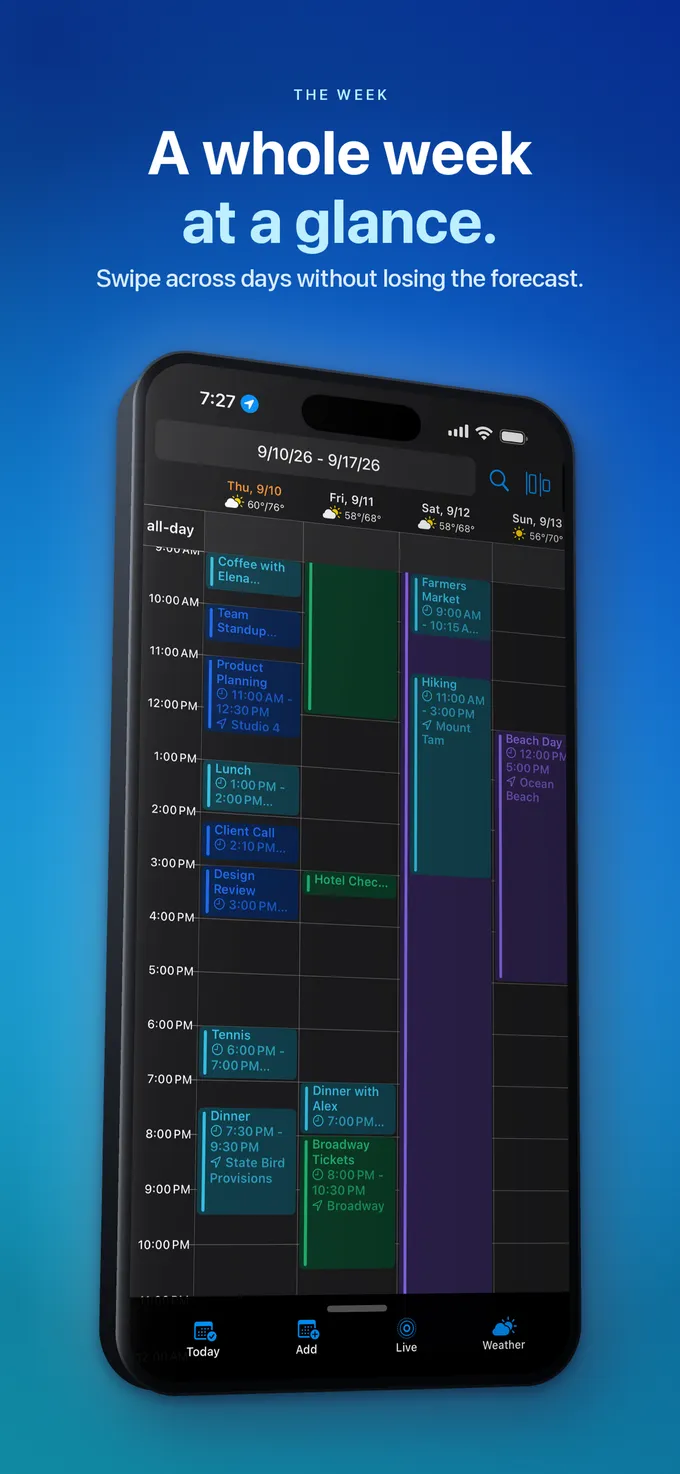

Cloud Calendars overview, using our product images. Provider settings and protocol examples described in this guide are separate from the screens shown here.
What to do
- Define workdays, days off and the cut-off hour.
- State inclusive counting or prior-day subtraction.
- Walk dates backward and skip every ineligible date.
- Check real capacity before saving execution blocks.
Questions
- Can I add one calendar day per holiday to a weekday formula?
- That shortcut can cross another weekend or another excluded day. Walk the eligible dates again instead.
- Does a Monday–Friday recurrence exclude public holidays?
- No. You need an explicitly confirmed holiday list and exceptions or separately bounded work blocks.