
DuPont 28-day shift calendar: map the cycle before repeating it
A DuPont calendar needs an exact roster, not just a repeat-every-four-weeks label. Map all 28 start-date positions and their day or night times first. A schedule name alone does not establish the order of shifts at your workplace.
Worked example to check against your calendar
| Cycle positions | Illustrative November 2026 starts | Type |
|---|---|---|
| 1–4 | 7–10 | Night |
| 5–7 | 11–13 | Off start-dates |
| 8–10 | 14–16 | Day |
| 11 | 17 | Off |
| 12–14 | 18–20 | Night |
| 15–17 | 21–23 | Off start-dates |
| 18–21 | 24–27 | Day |
| 22–28 | 28 November–4 December | Off |
Separate documented practice from the example
Henderson County EMS documents a modified DuPont schedule with seven day shifts, seven night shifts and seven consecutive days off in a 28-day cycle. That source does not specify every workplace’s exact ordering. The sequence here is an illustrative roster: 4 nights, 3 off, 3 days, 1 off, 3 nights, 3 off, 4 days, 7 off.
Starting 7 November 2026, use 07:00–19:00 for days and 19:00–07:00 next day for nights, in America/New_York. All dates in this example are after the autumn clock change, so these illustrative shifts each last 12 elapsed hours.
Measure gaps from the previous end
The first night block starts 7–10 November and ends 11 November at 07:00. The next day block starts 14 November at 07:00: a 72-hour gap. The second night block starts 18–20 November and ends 21 November at 07:00. The following day block starts 24 November at 07:00: another 72-hour gap.
These are elapsed gaps between endpoints, not a recommendation about recovery or an employer’s rules. Fourteen 12-hour intervals total 168 planned hours. A day label marked off can still contain the end of the preceding night shift.
Choose an entry method you can verify
An iCalendar model can represent each of the fourteen work-start positions as its own daily rule with INTERVAL=28. This avoids assuming an editor exposes a complex four-week weekday selector. It is a model, not evidence of any particular app’s import support.
If your roster editor has a rotation feature, preview the actual dates before exporting. Compare the last night of a block, the following day block and the boundary into the next cycle. Keep a finite review horizon and recheck employer changes rather than extending an unverified pattern indefinitely.
What it looks like
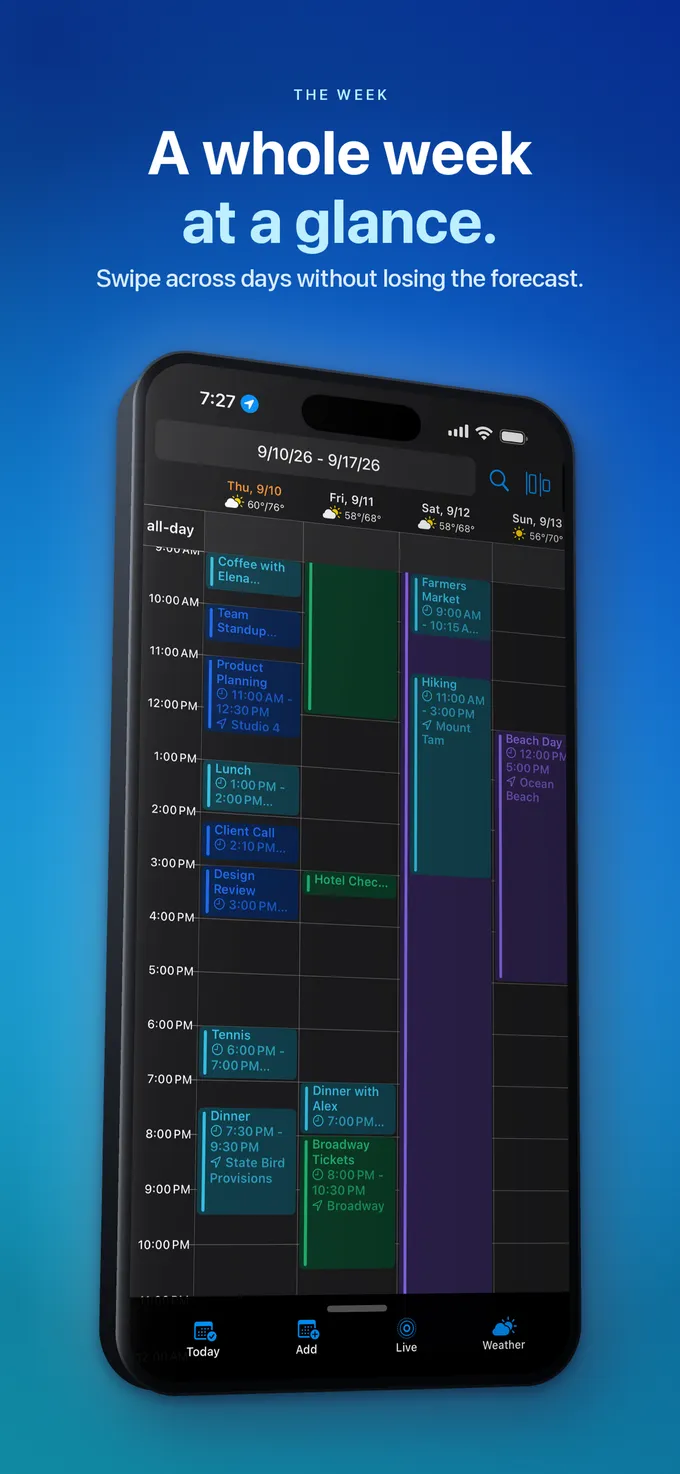
Cloud Calendars overview, using our product images. Provider settings and protocol examples described in this guide are separate from the screens shown here.
What to do
- Obtain the employer-approved 28-day sequence and start date.
- Assign an explicit start time and following-date end to every night.
- Count seven day starts and seven night starts in the sample cycle.
- Audit the next cycle and any clock-change weekend before sharing.
Questions
- Does every DuPont roster use this exact order?
- No. The employer source describes a modified schedule; your approved roster determines the order and phase.
- Can I group all matching weekdays into a four-week rule?
- Only if the generated dates exactly match the cycle. Separate 28-day start-position rules are a clearer reference model when weekday grouping is uncertain.