
Half-hour and quarter-hour time zones: calculate a meeting that fits
An hour line in London need not be an hour line in India or Nepal. Use the date and named city zone, then check the whole meeting against each person’s working hours. Fractional offsets and seasonal changes both matter.
Pairwise 09:00–18:00 working hours, calculated for two dates
| City | Jan 15: London 09:00 locally | Jan 15: London overlap | Jul 15: London 09:00 locally | Jul 15: London overlap |
|---|---|---|---|---|
| Kolkata | 14:30 | 09:00–12:30 London (3.5 h) | 13:30 | 09:00–13:30 London (4.5 h) |
| Kathmandu | 14:45 | 09:00–12:15 London (3.25 h) | 13:45 | 09:00–13:15 London (4.25 h) |
| St John’s | 05:30 | 12:30–18:00 London (5.5 h) | 05:30 | 12:30–18:00 London (5.5 h) |
| Adelaide | 19:30 | No 09:00–18:00 overlap | 17:30 | 09:00–09:30 London (0.5 h) |
Use a city and date, not an offset remembered from another season
IANA maintains civil time-zone rules. The calculations here use Python zoneinfo with the installed 2026e-rearguard database and named zones. They are worked examples, not live availability checks; future rule changes can change results.
RFC 5545 section 3.3.14 permits minute components in UTC offsets. That does not mean a DATE-TIME can be written with an arbitrary numeric offset: section 3.3.5 distinguishes UTC, floating time and a local time with TZID. Use those valid forms when inspecting an ICS file.
A meeting can start inside working hours and end outside them
On January 15, 2026, 12:00–13:00 London is 17:30–18:30 Kolkata. If the Kolkata workday ends at 18:00, half the meeting lies outside it. Moving the London slot to 11:30–12:30 produces 17:00–18:00 in Kolkata.
Google’s working-hours help documents the feature for work or school accounts and notes that an administrator may not enable it. Configuring those hours helps collaborators schedule; the arithmetic alone does not guarantee that every client displays a warning or rejects an invitation.
Find the intersection, not just the converted start
For each city, convert both ends of an assumed 09:00–18:00 workday to the same reference zone. The overlap starts at the later start and ends at the earlier end. If the end is no later than the start, there is no positive overlap.
The table applies that calculation to London and each city separately on January 15 and July 15, 2026. These are pairwise windows; they are not one window shared by all five cities.
Check the minute boundary before sending
India and Nepal differ by 15 minutes: 10:00 Kolkata is 10:15 Kathmandu on these dates. A whole-hour London start maps to :30 in Kolkata and :45 in Kathmandu. To reach an exact hour in Kathmandu, use :15 in London on these dates.
Inspect the saved start and end with the recipient’s city zone. Do not assume your calendar offers a specific 15-minute grid control; enter exact times in its supported editor if needed.
What it looks like
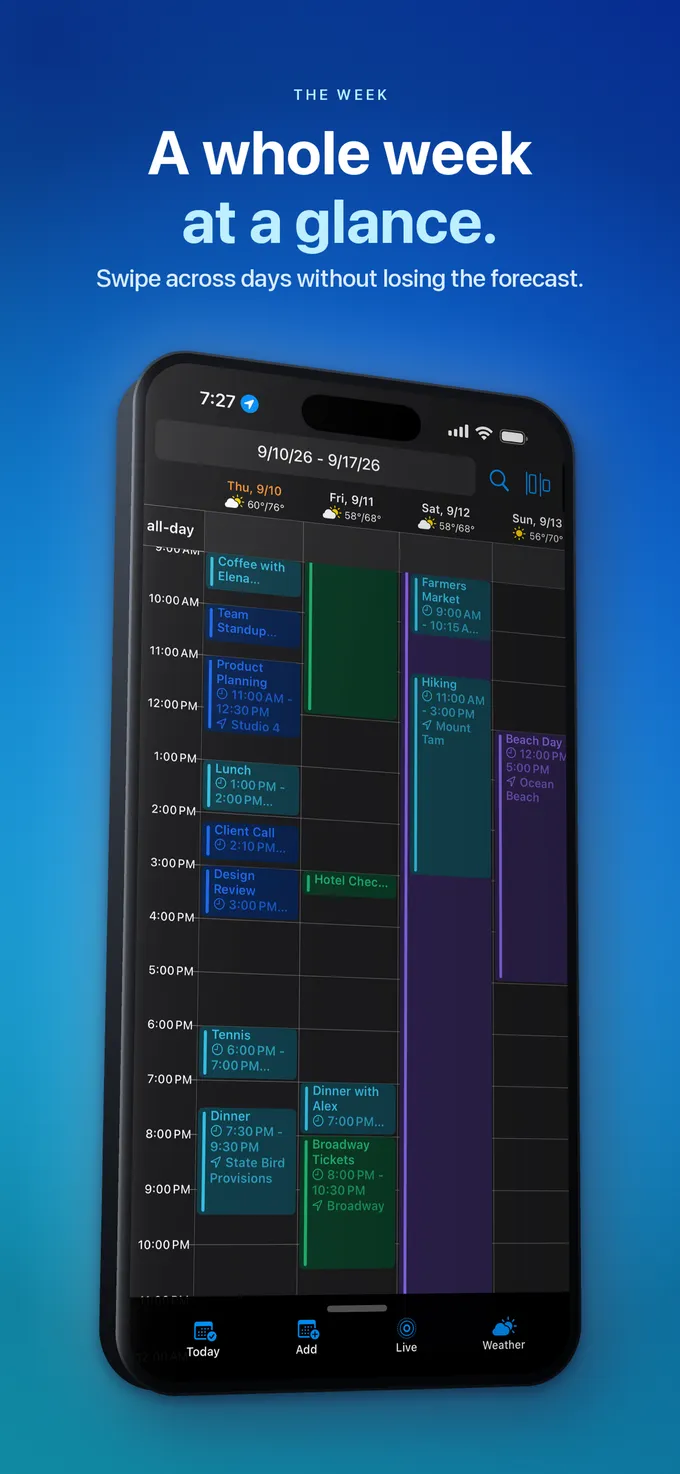

Cloud Calendars overview, using our product images. Provider settings and protocol examples described in this guide are separate from the screens shown here.
What to do
- Use an exact date and named city zone.
- Convert the full start–end interval.
- Intersect the two local workdays.
- Confirm a suitable slot with the recipient; a calculated overlap is not a booking.
Questions
- What is the London–Adelaide overlap for 09:00–18:00 workdays?
- On January 15, 2026 there is none. On July 15 there is half an hour, 09:00–09:30 London / 17:30–18:00 Adelaide. Different hours or dates require a fresh calculation.
- Do fractional zones always shift every meeting by 30 minutes?
- No. Compare both zones on the date. India and Nepal differ by 15 minutes; two half-hour-offset zones can differ by a whole number of hours.