
Direct Sync vs Cloud-Relay Calendar Privacy on iOS
Two calendar apps can look identical on your iPhone screen while handling your private schedule in completely different ways behind the scenes. Direct-sync apps (like Apple Calendar, BusyCal, and Cloud Calendars for local/EventKit/OAuth calendars) communicate straight between your iPhone and Apple, Google, or Microsoft—whereas cloud-relay apps ask you to create a vendor account that stores credentials or mirrors event metadata on an intermediary backend server to power push notifications, booking links, or cross-platform sets. Understanding all four iOS calendar storage models lets you minimize how many companies hold copies of where you sleep, travel, and meet. Arte Soft develops Cloud Calendars and publishes this comparison.
4 iOS Calendar Data-Flow & Privacy Architectures Compared
| Privacy Dimension | 1. On-Device Local (Cloud Calendars Local) | 2. Direct EventKit / OAuth (Cloud Calendars / Apple) | 3. Cloud-Relay Account Apps (Flexibits / TimeTree / OneCal) | 4. Zero-Knowledge E2EE (Proton / Tuta) |
|---|---|---|---|---|
| Where event titles & locations sit at rest | Exclusively on your iPhone/iPad flash storage | On your chosen provider (Apple, Google, Microsoft) + local iOS cache | On provider AND/OR mirrored on intermediary app vendor’s cloud servers | Encrypted ciphertext on Proton/Tuta servers + local app cache |
| Requires creating a vendor account just to open the app? | No — zero registration required | No vendor login needed for iCloud/local; direct Google/Microsoft OAuth | Yes — mandatory vendor account for sync sets, sharing, or cloud features | Yes — mandatory Proton/Tuta cryptographic account |
| Requires handing an Apple ID app-specific password to a server? | Never | Never — uses native iOS EventKit permission on device | Often required when syncing iCloud to non-Apple desktop/web relays | No (does not connect to iCloud CalDAV) |
| Number of companies in the trust chain | 1 (Apple hardware/OS) | 1–2 (Apple OS + your chosen cloud provider) | 2–3+ (Apple OS + cloud provider + intermediary relay vendor) | 2 (Apple OS + E2EE provider holding ciphertext) |
| Works with corporate security policies banning intermediary relays? | Yes (offline local) | High compatibility via iOS EventKit or direct OAuth | Frequently flagged by corporate infosec reviews if credentials are proxied | Isolated from corporate Exchange/Workspace |
| Multi-provider interoperability (iCloud + Google + M365) | Can combine local calendars alongside cloud ones in grid | Full two-way standard interoperability | High interoperability (at the cost of an extra cloud hop) | Low — isolated silo (read-only ICS imports only) |
| Weather location privacy | Optional GPS or manual city search via Apple WeatherKit | Apple WeatherKit (Cloud Calendars) or none (Apple Calendar) | Varies by third-party weather SDK & analytics | No weather SDKs |
How Cloud Calendars Separates Local/Direct Sync From Optional Cloud Sharing
Transparency matters more than marketing slogans in privacy architecture. In Cloud Calendars, three distinct modes operate only when you opt into them: (1) **Local calendars** run on your device with no account at all; (2) **iCloud, CalDAV, Google, and Microsoft** connect via Apple’s on-device EventKit store and official Google/Microsoft OAuth tokens; and (3) **Cloud Calendars’ own cross-user event/calendar sharing** uses a verified email sign-in only when you explicitly share a Cloud Calendars calendar or event link with another person.
Furthermore, Free tier users see advertising (supported via `app-ads.txt`), whereas upgrading to Advanced (`$0.49/month` or `$4.99/year`) removes ads completely across the entire app.
Account Sync, Credential Handling & Ad-Tech Comparison on iOS
| App | Vendor Account Required? | iCloud Connection Method | Advertising in Free Tier? |
|---|---|---|---|
| Cloud Calendars | No for local, iCloud, Google & M365; email sign-in only for native sharing | On-device iOS EventKit permission (no app password) | Yes in Free ($0); zero ads in Advanced ($4.99/yr) & Premium |
| Apple Calendar | Apple Account (optional if using On My iPhone only) | First-party OS iCloud daemon | Zero ads ($0) |
| BusyCal iOS | No BusyMac account required | On-device EventKit or direct CalDAV | Zero ads ($14.99 upfront) |
| Fantastical | Flexibits account required for Premium, Sets & Openings | EventKit on iOS; app-specific password if synced via Flexibits cloud/Windows | Zero ads (~$56.99/yr subscription) |
| Notion Calendar | Google/Notion login required | Apple app-specific password stored to bridge iCloud | Zero ads ($0) |
| TimeTree / Cozi | Mandatory vendor account | Read-only import/overlay or proprietary cloud calendar | Ad-supported free tiers; ~$39–$45/yr ad-free |
Pricing and Choosing the Least-Privilege Calendar Setup
Good security engineering follows the principle of least privilege: never grant a third server a long-lived Apple app-specific password or OAuth write scope when on-device EventKit or scoped local storage already solves the job.
Use the decision matrix below to pick the cleanest trust boundary for your schedule.
Pricing & Best Choice by Privacy Requirement
| Privacy Goal | Recommended Setup | Cost | Why It Minimizes Exposure |
|---|---|---|---|
| Zero cloud servers — events stay strictly on iPhone hardware | Cloud Calendars (Local calendar + Advanced ad-free) or Apple "On My iPhone" | $0 – $4.99/yr | No cloud sync, no OAuth tokens, no ads (with Advanced) |
| iCloud + Google unified on iPhone without an intermediary relay server + ad-free | Cloud Calendars Advanced ($4.99/yr) or BusyCal ($14.99 once) | $4.99/yr or $14.99 once | Direct EventKit + Google OAuth; zero ad networks active |
| Apple Advanced Data Protection (E2EE iCloud Backup) + zero third-party apps | Built-in Apple Calendar | $0 | Smallest software footprint on iOS (note: iCloud Calendar itself uses standard Apple encryption for CalDAV compatibility) |
| End-to-end encrypted cloud sync where even the server host cannot read titles | Proton Calendar or Tuta Calendar | $0 basic / ~$40–$120/yr | Client-side public-key encryption before upload |
| Self-hosted open-source cloud on your own home NAS or VPS | Nextcloud / Radicale / Baïkal via iOS CalDAV + Cloud Calendars | Self-hosted + $0/$4.99 yr | You control the physical server and TLS logs |
| Checking weather without granting continuous background GPS tracking | Cloud Calendars Weather Hub using manual city search instead of GPS | $0 – $4.99/yr | Fetches Apple WeatherKit for a named city without live coordinates |
iOS 17 / iOS 18 Calendar Permissions: Write-Only vs Full Access
Starting in iOS 17 and continuing in iOS 18, Apple split Calendar privacy permissions into `Add Events Only` (for airline or ticketing apps that just drop one reservation onto your calendar without reading anything) and `Full Access` (required by actual calendar viewers like Cloud Calendars to display your week).
Audit `Settings > Privacy & Security > Calendars` periodically on your iPhone and downgrade shopping, fitness, or social-media apps from `Full Access` to `None` or `Add Events Only`—only dedicated calendar apps need permission to read your life history.
Manual City Weather Search for Location-Conscious Users
If you keep iPhone Location Services disabled for most apps, you still don’t have to give up in-calendar weather forecasts. Inside Cloud Calendars’ Weather Hub, search and select your city by name instead of granting GPS access—Apple WeatherKit returns hourly and 10-day forecasts for that city without reading your device’s street-level coordinates.
What it looks like
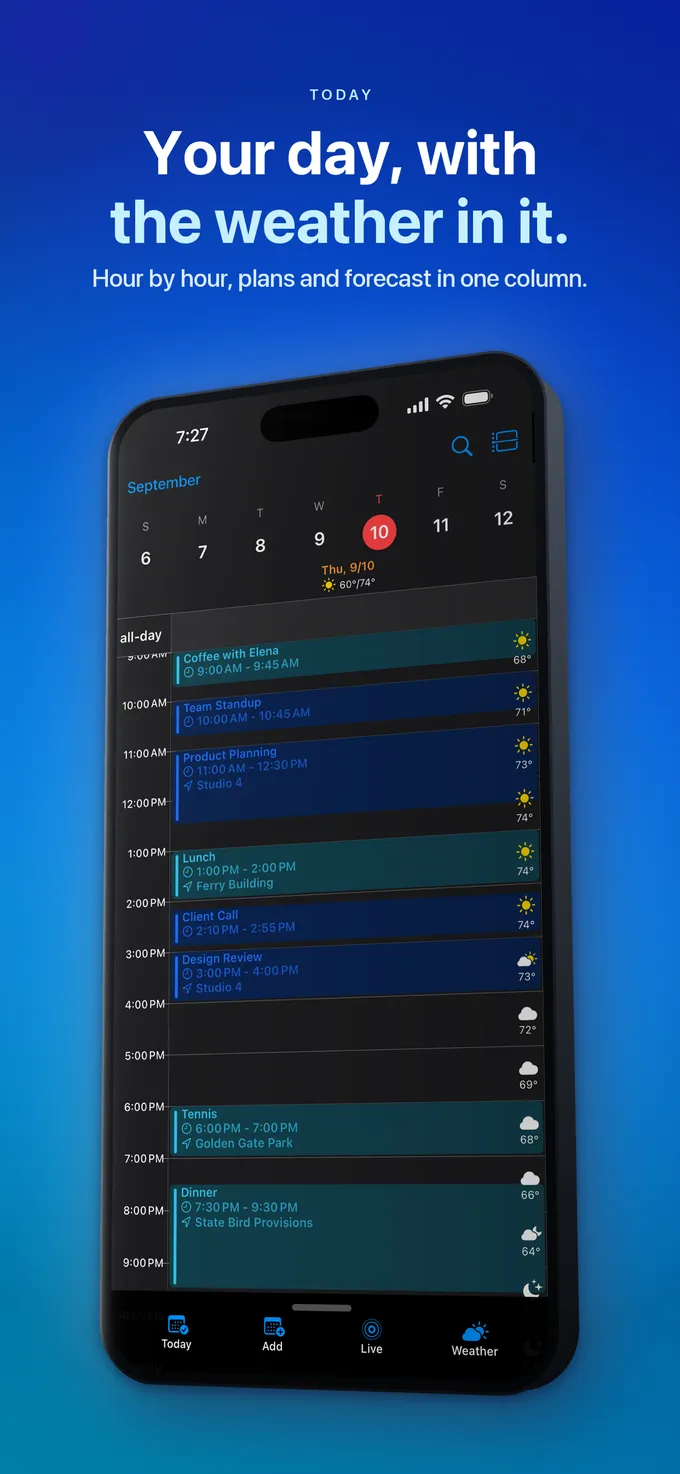
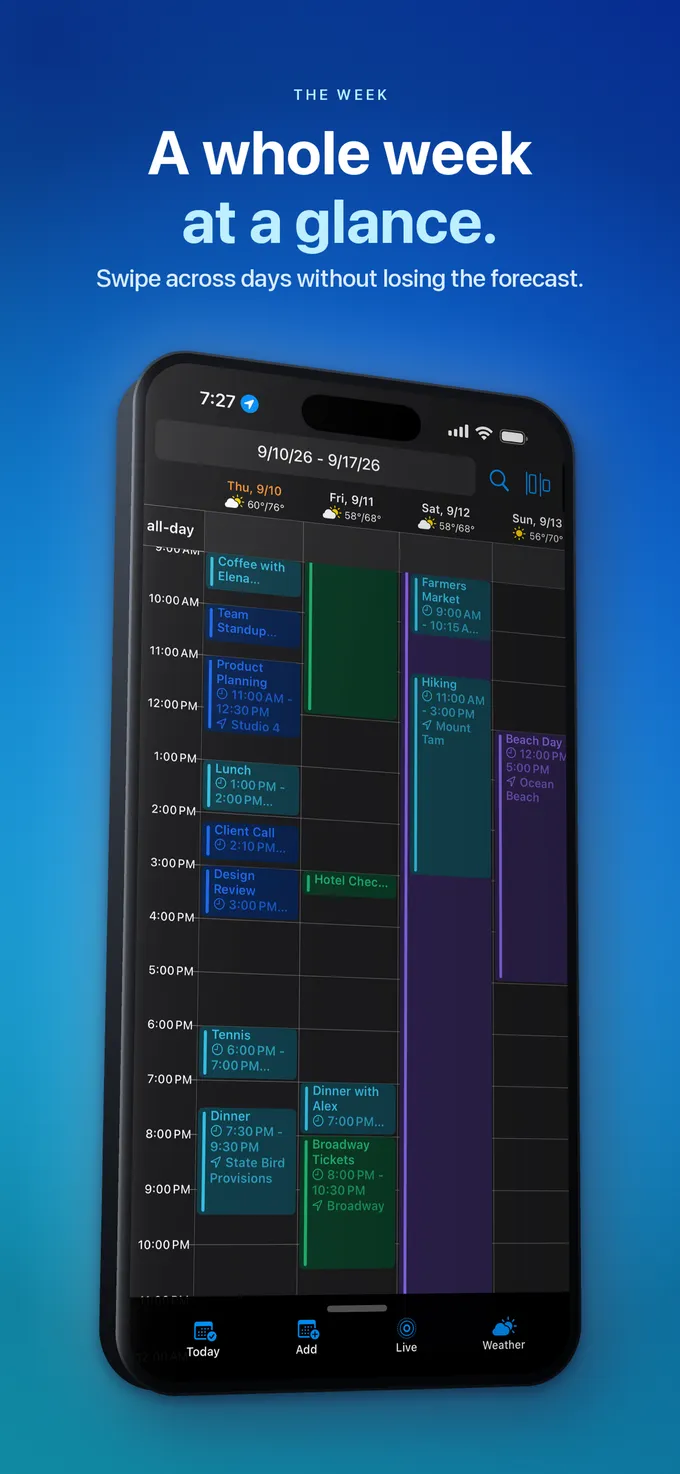
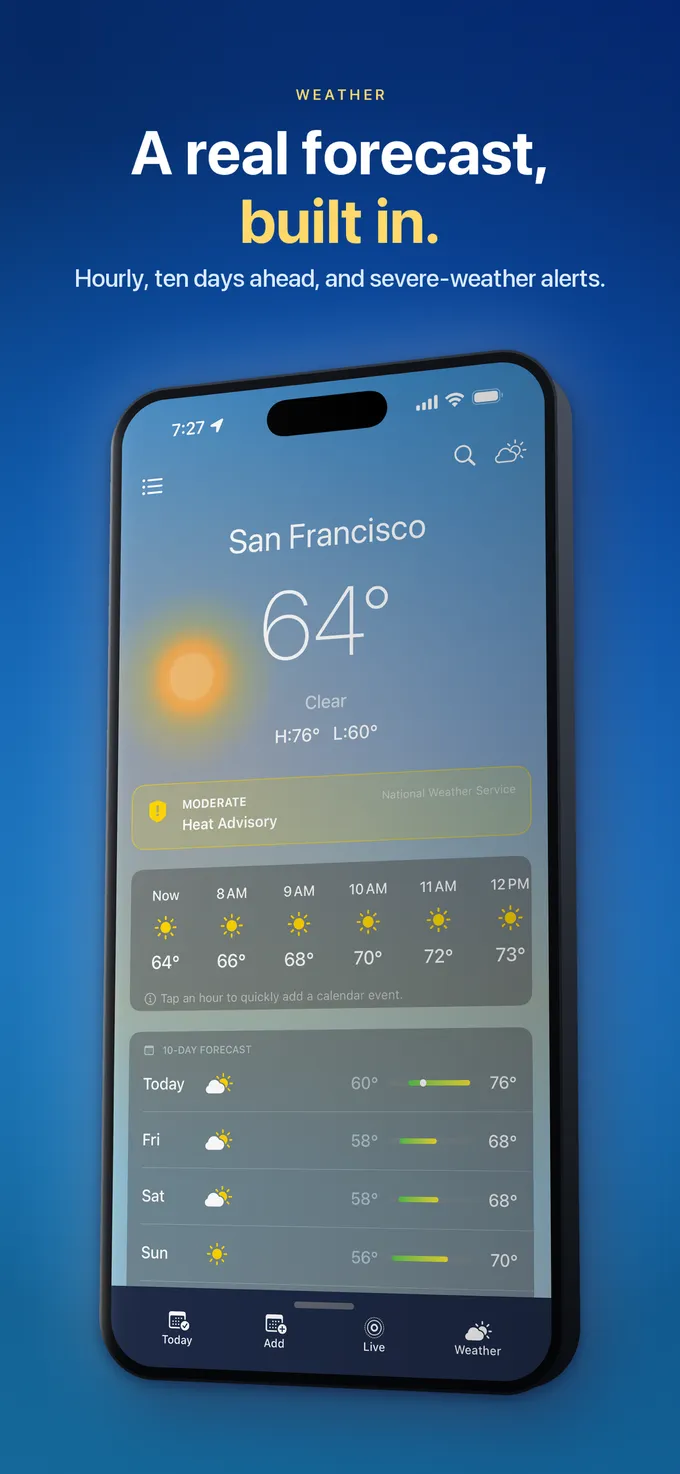
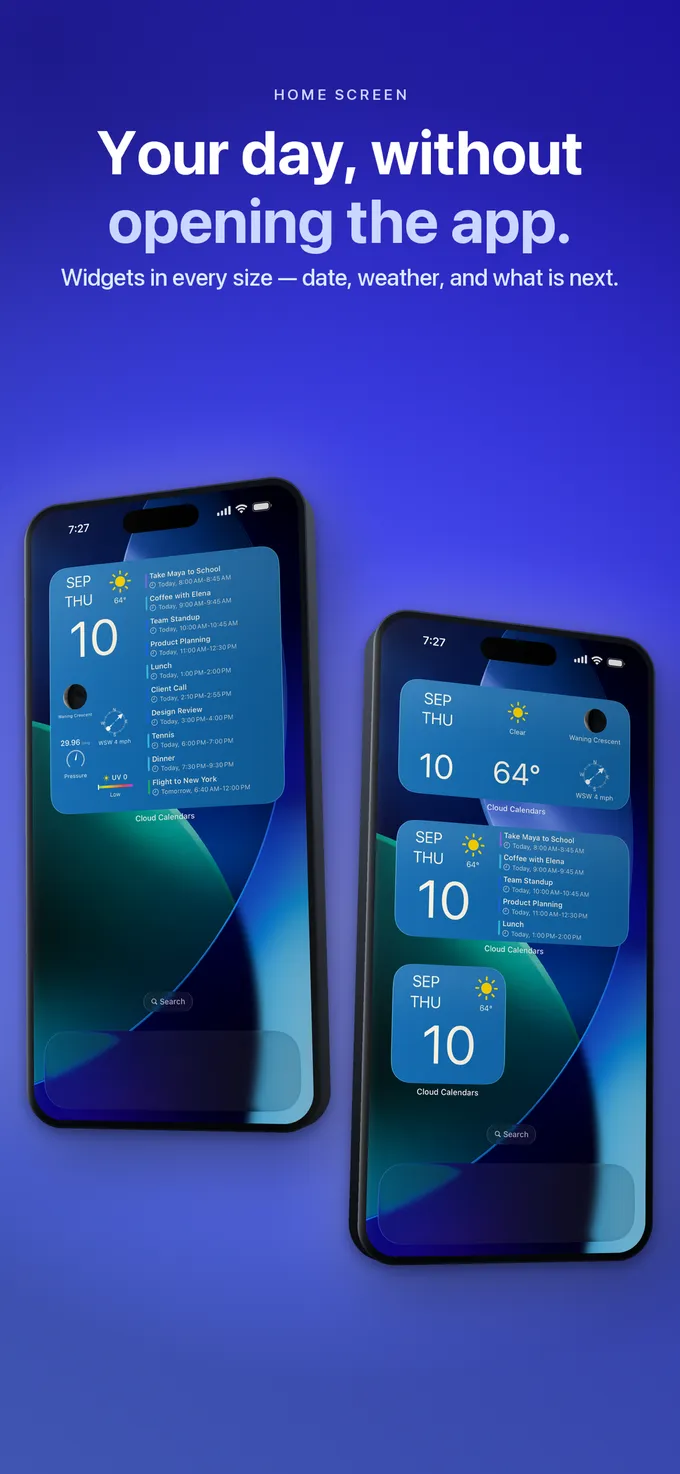
What to do
- Open iPhone Settings > Privacy & Security > Calendars and revoke Full Access from non-calendar apps (games, social apps, airline apps that only need Add Events Only).
- Avoid generating Apple ID app-specific passwords for third-party cloud relays when native iOS EventKit apps like Cloud Calendars can read iCloud directly on device.
- If you want zero ad-network requests alongside direct sync, upgrade Cloud Calendars to Advanced ($4.99/year) or use Apple Calendar / BusyCal.
- Use manual city search inside Cloud Calendars’ Weather Hub if you prefer not to share device GPS location.
- Periodically review connected third-party OAuth tokens at myaccount.google.com/permissions and account.live.com/consent/Manage.
Questions
- Do I have to create an account to use Cloud Calendars?
- No. You can use local calendars on your iPhone or iPad and view EventKit calendars without creating a Cloud Calendars account. Signing in is only needed when connecting external calendar services or using Cloud Calendars’ cross-user sharing.
- Is Apple iCloud Calendar end-to-end encrypted under Advanced Data Protection?
- Per Apple’s official iCloud data security documentation, iCloud Calendars and Contacts use standard transport and at-rest encryption rather than Advanced Data Protection end-to-end encryption because they must interoperate with open CalDAV and email scheduling standards. For true E2EE cloud calendars, use Proton or Tuta—or use purely local device calendars.
- How do I remove ads completely in Cloud Calendars?
- Subscribing to Cloud Calendars Advanced ($0.49/month or $4.99/year) or Premium removes all advertising across the app.