
24/48 firefighter calendar: add a Kelly day without shifting the roster
A 24-on/48-off roster repeats every three days, so its starts move through the week. A Kelly day removes an assigned tour according to the employer’s pattern; it should not accidentally shift every later start.
Worked example to check against your calendar
| Start position | Illustrative date | Result |
|---|---|---|
| Day 16 | 16 November, 07:00 | Tour ends 17 November, 07:00 |
| Day 19 | 19 November, 07:00 | Kelly exception in this illustration |
| Day 22 | 22 November, 07:00 | Original base start retained |
Confirm which tour is removed
South Burlington Fire’s recruitment page describes a 24-hour-on, 48-hour-off schedule with a Kelly day every seventh shift. That is a documented example, not a rule for every fire department. Obtain your platoon’s anchor date and Kelly-day phase from the approved roster.
For an illustrative schedule with day 1 on Sunday 1 November 2026 at 07:00, starts fall on days 1, 4, 7, 10, 13, 16 and 19. The next start is day 22. Consecutive starts advance three weekdays; the weekday pattern returns after 21 days.
Keep the underlying three-day series
A recurrence model for the base starts is FREQ=DAILY;INTERVAL=3. A Kelly exception should exclude the assigned tour while leaving the later starts unchanged. RFC 5545 defines EXDATE as one way to exclude an occurrence, but a provider may represent an edited or cancelled instance differently.
In this example, remove day 19, the seventh scheduled tour, only after confirming that is the correct phase. Day 16 ends at 07:00 on day 17, and the next actual start remains day 22 at 07:00. In this no-clock-change interval, the gap is 120 elapsed hours. It is not a new six-day repeating base schedule.
Inspect the exception scope
Google’s recurring-event documentation says to choose which events an edit applies to, but it does not promise a particular export representation. Confirm the selected occurrence is removed and inspect the next two retained tours. If the app cannot express the exception reliably, keep a checked finite roster instead.
A 24-hour wall-clock handover interval can have a different elapsed length across a daylight-saving change. Check those weekends separately. Calendar intervals do not establish paid hours, staffing rules or leave entitlements.
What it looks like
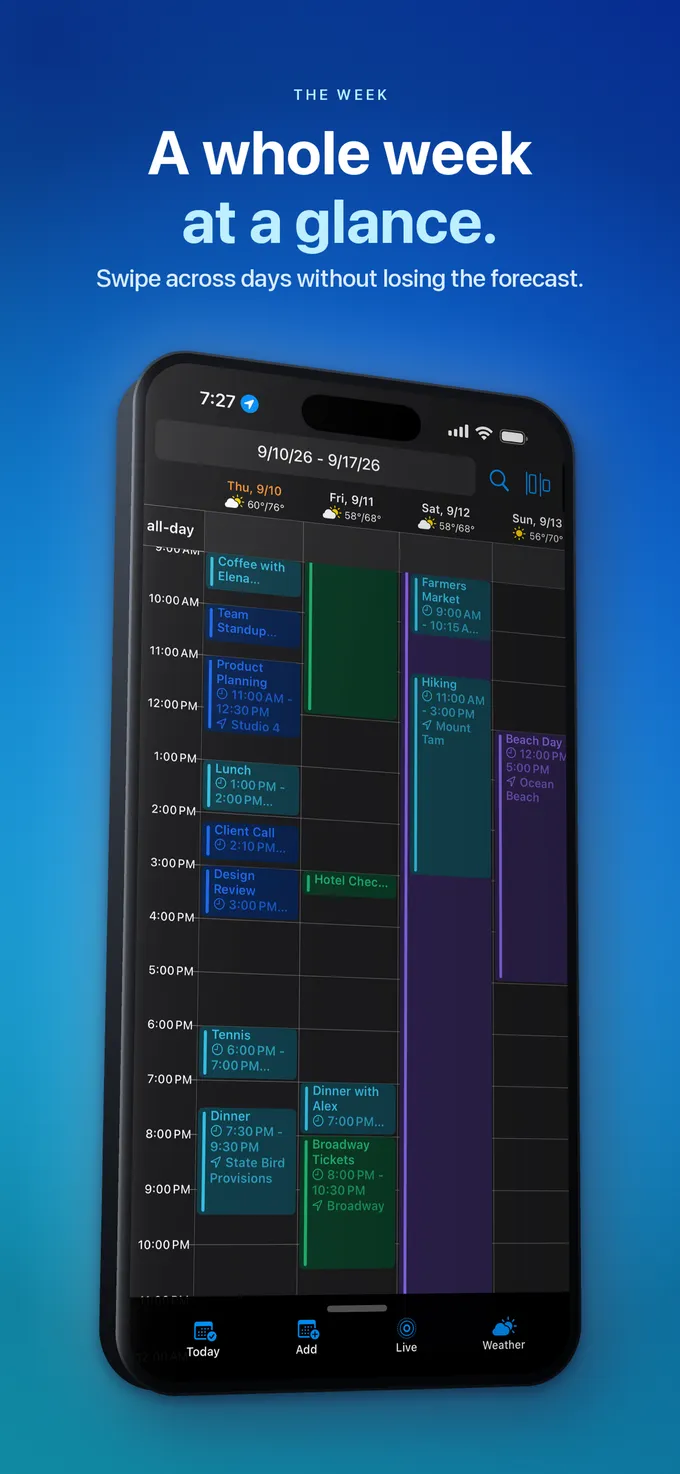
Cloud Calendars overview, using our product images. Provider settings and protocol examples described in this guide are separate from the screens shown here.
What to do
- Check the platoon anchor, handover time and Kelly phase.
- Build the three-day starts over a finite sample.
- Remove only the approved occurrence and retain its roster reference.
- Check the next two tours and daylight-saving endpoints.
Questions
- Should I use weekly weekday checkboxes?
- A three-day interval does not stay on the same weekdays, so a weekly selection alone does not model the base cycle.
- Will deleting one occurrence always create an EXDATE?
- No. That is a standard representation, not a guarantee about a provider’s internal storage or export.