
On-call calendar: separate coverage from confirmed work
An on-call window answers who is responsible for coverage. A confirmed work block answers when an activity is planned. Keep those records distinct, and do not assume standby should always appear free.
Worked example to check against your calendar
| Layer | Illustrative quantity | Meaning |
|---|---|---|
| Coverage envelope | 168 hours | Responsibility window |
| Regular work | 40 hours | Planned activity |
| Non-overlapping call-outs | 7 hours | Additional activity |
| Remainder inside coverage | 121 hours | Not automatically available or unpaid |
Record the handover as an exact interval
For an illustrative week, coverage begins Monday 2 November 2026 at 08:00 and ends Monday 9 November at 08:00 in America/New_York. There is no clock change inside this interval, so it spans 168 elapsed hours. A Monday-through-Sunday all-day banner does not express the same endpoints.
An all-day label can provide context, but preserve the exact handover times in a timed reference or clearly visible notes. Use a title identifying the coverage role, and keep any contact or escalation details within the appropriate sharing audience.
Choose availability from the actual constraints
Do not mark all on-call time free as a blanket rule. If the duty prevents accepting another commitment, busy may be the appropriate status. If some bookings are acceptable, decide with the responsible team which time is genuinely available and verify the behavior in the actual booking workflow.
RFC 5545 TRANSP distinguishes whether an event contributes to busy-time searches. It does not classify paid work, guarantee a provider’s booking integration or prove that a person is available. A secondary calendar is not automatically excluded from every availability calculation.
Avoid double-counting coverage and activity
Suppose the week contains 40 hours of regular planned work and seven hours of call-outs outside those regular blocks. The coverage envelope is still 168 hours. The non-overlapping regular-plus-call-out total is 47 hours, leaving 121 hours outside those activity blocks but still inside coverage.
That remainder is not unrestricted leisure and does not establish paid standby. If a call-out overlaps regular work, calculate the union of occupied intervals rather than adding both durations. Review actual callbacks separately from planned ones and preserve the original coverage reference.
What it looks like
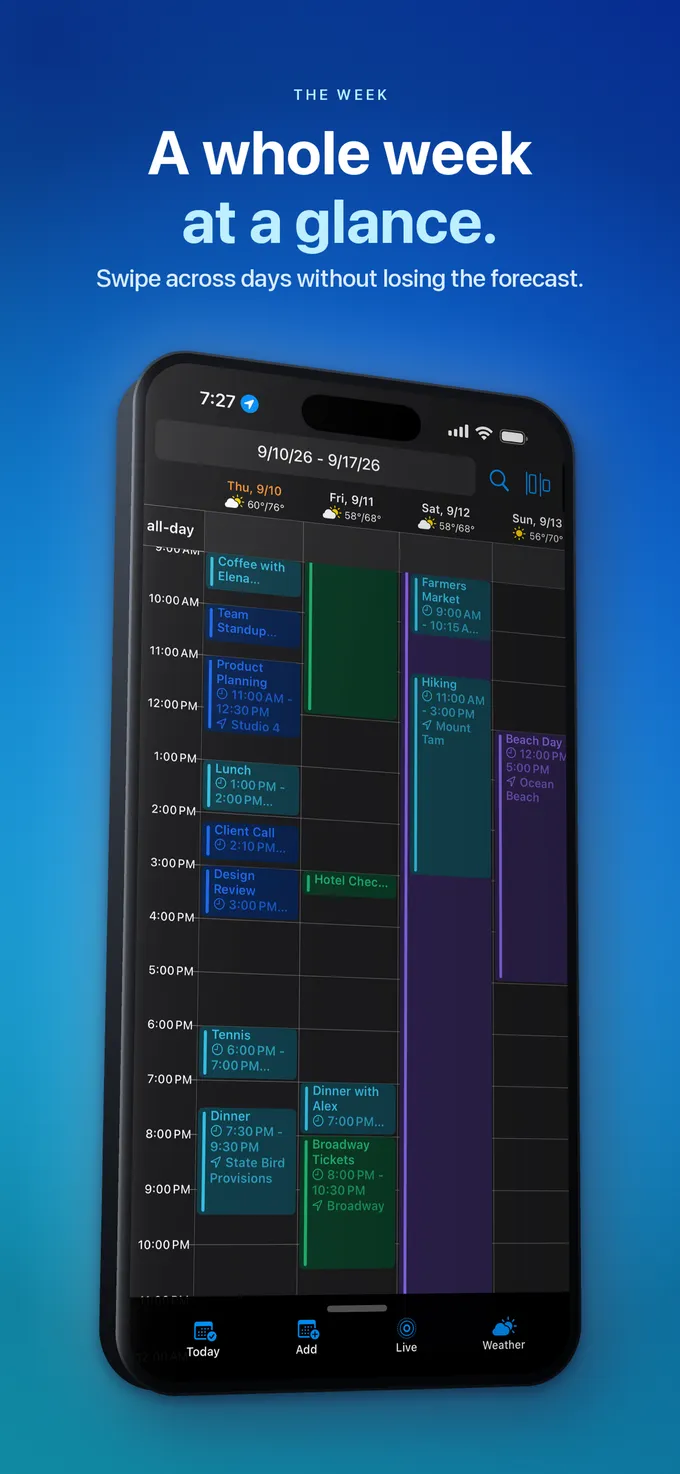
Cloud Calendars overview, using our product images. Provider settings and protocol examples described in this guide are separate from the screens shown here.
What to do
- Record exact start and end handovers.
- Keep coverage and confirmed activity as distinct records.
- Choose busy status from duty constraints, not a universal standby rule.
- Test what an intended viewer or booking tool sees.
Questions
- Should standby always be marked free?
- No. That depends on the duty and which commitments are allowed.
- Can I add all three durations together?
- No. The coverage window contains the activity blocks; adding them double-counts time.